Find a dress shape for your body and the occasion
Choose your body shape and the occasion, and the free dress finder shows the cuts, necklines, length, sleeves and fabrics worth trying first, drawn as pattern pieces, plus what to check before you buy.
For hourglass, pear, apple, rectangle (athletic) and inverted triangle shapes, and for wedding guest, work, cocktail, summer and black-tie dresses.
Find a dress
The dress finder
Five body shapes, five occasions. Choose one of each and the pattern pieces redraw for that pair. These are rules of thumb about balance and emphasis, not rules you have to follow.
Pear, wedding guest
Bring the eye up and out at the shoulders, keep the waist marked, and let the skirt move past the hips with ease instead of gripping them.
Cut
Neckline
A wide, shallow line from shoulder to shoulder: broadens the shoulder line and balances wider hips.
All thirteen necklinesLength
Midi
Mid-calf balances the volume of the skirt; aim for the slimmest point of your calf.
Check a dress length against your bodySleeves
Fabric
A skirt fabric with a little body (crepe, poplin, taffeta) floats past the hip; thin clingy knits trace it.
Take care with
For your shape
- Bias-cut satin and thin jersey trace every line of the hip. If you love a slip dress, choose a heavier satin and size for the hips.
- Hip-level details (flap pockets, a peplum that ends at the hip, side bows) add width exactly where the frame is widest. Fine if that is the emphasis you want.
- Pencil skirts in a stiff fabric tend to ride up and crease across the thighs; a little stretch or a walking vent helps.
For the occasion
- Skip white, ivory and anything that photographs as white, unless the couple asks for it.
- Read the dress code on the invitation: an evening or black-tie wedding calls for longer and dressier.
- You will sit through a ceremony, eat and probably dance. Sit down and raise your arms in the fitting room.
Put the interest up top: a boat or square neckline, flutter or puff sleeves, a print or embellishment on the bodice and a plainer skirt.
Hourglass, wedding guest
Follow the waist instead of skipping over it. Dresses shaped at the waist, in fabrics that drape, sit closest to your natural lines.
Cut
Neckline
Draws a vertical line down the center and lengthens the neck. Opens up a full bust and narrows a wide shoulder line visually.
All thirteen necklinesLength
Midi
Midi reads dressy enough for most ceremonies and lets the skirt swing.
Check a dress length against your bodySleeves
Fabric
Fabrics with some drape follow the curve from bust to waist to hip; very stiff fabrics stand away from the waist.
Take care with
For your shape
- Straight, unshaped cuts (a boxy shift, a tent dress) hang from the bust and lose the waist. Add a belt, or pick a version with darts.
- Shirt dresses: fit the bust first and have the waist taken in, or the buttons tend to pull open across the chest.
- A high, stiff neckline on a full bust can read as one block from chin to waist; a narrow V or keyhole opens it up.
For the occasion
- Skip white, ivory and anything that photographs as white, unless the couple asks for it.
- Read the dress code on the invitation: an evening or black-tie wedding calls for longer and dressier.
- You will sit through a ceremony, eat and probably dance. Sit down and raise your arms in the fitting room.
Ask for waist definition in every option: a seam, a tie or a belt. A wrap in a printed crepe works from a garden ceremony to an evening reception.
Hourglass, work
Follow the waist instead of skipping over it. Dresses shaped at the waist, in fabrics that drape, sit closest to your natural lines.
Cut
Neckline
Draws a vertical line down the center and lengthens the neck. Opens up a full bust and narrows a wide shoulder line visually.
All thirteen necklinesLength
Knee length
Knee or just below stays put when you sit at a desk.
Check a dress length against your bodySleeves
Fabric
Fabrics with some drape follow the curve from bust to waist to hip; very stiff fabrics stand away from the waist.
Take care with
For your shape
- Straight, unshaped cuts (a boxy shift, a tent dress) hang from the bust and lose the waist. Add a belt, or pick a version with darts.
- Shirt dresses: fit the bust first and have the waist taken in, or the buttons tend to pull open across the chest.
- A high, stiff neckline on a full bust can read as one block from chin to waist; a narrow V or keyhole opens it up.
For the occasion
- Sit down in it before you buy: hems ride up a couple of inches when you are seated.
- Office dress codes vary a lot by industry; when unsure, plan a jacket or cardigan over it.
- Machine-washable ponte and crepe are the easiest dresses to wear every week.
Choose a sheath with a waist seam or vertical darts rather than a straight shift. If shirt dresses gape at your bust, size up and have the waist taken in.
Hourglass, cocktail
Follow the waist instead of skipping over it. Dresses shaped at the waist, in fabrics that drape, sit closest to your natural lines.
Cut
Neckline
Draws a vertical line down the center and lengthens the neck. Opens up a full bust and narrows a wide shoulder line visually.
All thirteen necklinesLength
Knee length
Knee length keeps a fitted cut easy to walk and sit in.
Check a dress length against your bodySleeves
Fabric
Fabrics with some drape follow the curve from bust to waist to hip; very stiff fabrics stand away from the waist.
Take care with
For your shape
- Straight, unshaped cuts (a boxy shift, a tent dress) hang from the bust and lose the waist. Add a belt, or pick a version with darts.
- Shirt dresses: fit the bust first and have the waist taken in, or the buttons tend to pull open across the chest.
- A high, stiff neckline on a full bust can read as one block from chin to waist; a narrow V or keyhole opens it up.
For the occasion
- Cocktail usually means knee to midi length and a dressier fabric than daywear.
- Velvet and heavier satin suit winter evenings; chiffon and crepe suit warm ones.
- A little shine or texture goes a long way; let one element be the statement.
A sweetheart or square neckline with a defined waist is a classic pairing. If you choose satin, a crepe-back satin is less revealing of underwear lines.
Hourglass, summer casual
Follow the waist instead of skipping over it. Dresses shaped at the waist, in fabrics that drape, sit closest to your natural lines.
Cut
Neckline
Draws a vertical line down the center and lengthens the neck. Opens up a full bust and narrows a wide shoulder line visually.
All thirteen necklinesLength
Midi
A midi in a light fabric moves and stays cool on bare legs.
Check a dress length against your bodySleeves
Fabric
Fabrics with some drape follow the curve from bust to waist to hip; very stiff fabrics stand away from the waist.
Take care with
For your shape
- Straight, unshaped cuts (a boxy shift, a tent dress) hang from the bust and lose the waist. Add a belt, or pick a version with darts.
- Shirt dresses: fit the bust first and have the waist taken in, or the buttons tend to pull open across the chest.
- A high, stiff neckline on a full bust can read as one block from chin to waist; a narrow V or keyhole opens it up.
For the occasion
- Linen, cotton and viscose breathe better than polyester in heat.
- Light colors in thin cotton can turn see-through in sunlight. Hold it against a window, or pick a lined dress.
- Linen creases; that is part of its charm, but a linen blend looks pressed for longer.
Belt it. Most summer dresses are cut loose, and a narrow belt or a tie brings the waist back. A smocked waist does the same without a belt.
Hourglass, formal or black tie
Follow the waist instead of skipping over it. Dresses shaped at the waist, in fabrics that drape, sit closest to your natural lines.
Cut
Neckline
Draws a vertical line down the center and lengthens the neck. Opens up a full bust and narrows a wide shoulder line visually.
All thirteen necklinesLength
Floor length
Floor length for black tie, hemmed with the shoes you will wear.
Check a dress length against your bodySleeves
Fabric
Fabrics with some drape follow the curve from bust to waist to hip; very stiff fabrics stand away from the waist.
Take care with
For your shape
- Straight, unshaped cuts (a boxy shift, a tent dress) hang from the bust and lose the waist. Add a belt, or pick a version with darts.
- Shirt dresses: fit the bust first and have the waist taken in, or the buttons tend to pull open across the chest.
- A high, stiff neckline on a full bust can read as one block from chin to waist; a narrow V or keyhole opens it up.
For the occasion
- Black tie traditionally means a floor-length gown. For black tie optional, many hosts also welcome an elegant midi or tea length.
- Boning or a built-in bra keeps strapless and low-back bodices in place through a long evening.
- Bring the shoes you will wear to the hem fitting: floor length is set with the heels on.
A sweetheart or off-shoulder bodice with a marked waist suits both gown shapes. Have the waist fitted closely; a gown that is right at the bust but loose at the waist loses its line.
Pear, wedding guest
Bring the eye up and out at the shoulders, keep the waist marked, and let the skirt move past the hips with ease instead of gripping them.
Cut
Neckline
A wide, shallow line from shoulder to shoulder: broadens the shoulder line and balances wider hips.
All thirteen necklinesLength
Midi
Mid-calf balances the volume of the skirt; aim for the slimmest point of your calf.
Check a dress length against your bodySleeves
Fabric
A skirt fabric with a little body (crepe, poplin, taffeta) floats past the hip; thin clingy knits trace it.
Take care with
For your shape
- Bias-cut satin and thin jersey trace every line of the hip. If you love a slip dress, choose a heavier satin and size for the hips.
- Hip-level details (flap pockets, a peplum that ends at the hip, side bows) add width exactly where the frame is widest. Fine if that is the emphasis you want.
- Pencil skirts in a stiff fabric tend to ride up and crease across the thighs; a little stretch or a walking vent helps.
For the occasion
- Skip white, ivory and anything that photographs as white, unless the couple asks for it.
- Read the dress code on the invitation: an evening or black-tie wedding calls for longer and dressier.
- You will sit through a ceremony, eat and probably dance. Sit down and raise your arms in the fitting room.
Put the interest up top: a boat or square neckline, flutter or puff sleeves, a print or embellishment on the bodice and a plainer skirt.
Pear, work
Bring the eye up and out at the shoulders, keep the waist marked, and let the skirt move past the hips with ease instead of gripping them.
Cut
Neckline
A wide, shallow line from shoulder to shoulder: broadens the shoulder line and balances wider hips.
All thirteen necklinesLength
Just below the knee
Just below the knee keeps the skirt from riding up over the thighs when you sit.
Check a dress length against your bodySleeves
Fabric
A skirt fabric with a little body (crepe, poplin, taffeta) floats past the hip; thin clingy knits trace it.
Take care with
For your shape
- Bias-cut satin and thin jersey trace every line of the hip. If you love a slip dress, choose a heavier satin and size for the hips.
- Hip-level details (flap pockets, a peplum that ends at the hip, side bows) add width exactly where the frame is widest. Fine if that is the emphasis you want.
- Pencil skirts in a stiff fabric tend to ride up and crease across the thighs; a little stretch or a walking vent helps.
For the occasion
- Sit down in it before you buy: hems ride up a couple of inches when you are seated.
- Office dress codes vary a lot by industry; when unsure, plan a jacket or cardigan over it.
- Machine-washable ponte and crepe are the easiest dresses to wear every week.
Structured shoulders help here: a boat neck, a cap sleeve or a cropped jacket balances the hips. A pencil-style sheath can work too if the fabric has stretch and a vent.
Pear, cocktail
Bring the eye up and out at the shoulders, keep the waist marked, and let the skirt move past the hips with ease instead of gripping them.
Cut
Neckline
A wide, shallow line from shoulder to shoulder: broadens the shoulder line and balances wider hips.
All thirteen necklinesLength
Knee length
Knee length with a flared skirt keeps the proportions light.
Check a dress length against your bodySleeves
Fabric
A skirt fabric with a little body (crepe, poplin, taffeta) floats past the hip; thin clingy knits trace it.
Take care with
For your shape
- Bias-cut satin and thin jersey trace every line of the hip. If you love a slip dress, choose a heavier satin and size for the hips.
- Hip-level details (flap pockets, a peplum that ends at the hip, side bows) add width exactly where the frame is widest. Fine if that is the emphasis you want.
- Pencil skirts in a stiff fabric tend to ride up and crease across the thighs; a little stretch or a walking vent helps.
For the occasion
- Cocktail usually means knee to midi length and a dressier fabric than daywear.
- Velvet and heavier satin suit winter evenings; chiffon and crepe suit warm ones.
- A little shine or texture goes a long way; let one element be the statement.
Off-shoulder and square necklines widen the shoulder line to match the hips. If you want sparkle, put it on the bodice.
Pear, summer casual
Bring the eye up and out at the shoulders, keep the waist marked, and let the skirt move past the hips with ease instead of gripping them.
Cut
Neckline
A wide, shallow line from shoulder to shoulder: broadens the shoulder line and balances wider hips.
All thirteen necklinesLength
Midi
A midi lets a tiered or A-line skirt fall cleanly; above the knee also works in lighter fabrics.
Check a dress length against your bodySleeves
Fabric
A skirt fabric with a little body (crepe, poplin, taffeta) floats past the hip; thin clingy knits trace it.
Take care with
For your shape
- Bias-cut satin and thin jersey trace every line of the hip. If you love a slip dress, choose a heavier satin and size for the hips.
- Hip-level details (flap pockets, a peplum that ends at the hip, side bows) add width exactly where the frame is widest. Fine if that is the emphasis you want.
- Pencil skirts in a stiff fabric tend to ride up and crease across the thighs; a little stretch or a walking vent helps.
For the occasion
- Linen, cotton and viscose breathe better than polyester in heat.
- Light colors in thin cotton can turn see-through in sunlight. Hold it against a window, or pick a lined dress.
- Linen creases; that is part of its charm, but a linen blend looks pressed for longer.
Puff and flutter sleeves add width at the shoulders and are cool to wear. Pick a print with the bigger motifs on top, or a solid skirt and printed bodice.
Pear, formal or black tie
Bring the eye up and out at the shoulders, keep the waist marked, and let the skirt move past the hips with ease instead of gripping them.
Cut
Neckline
A wide, shallow line from shoulder to shoulder: broadens the shoulder line and balances wider hips.
All thirteen necklinesLength
Floor length
Floor length lets a full or A-line skirt complete its shape.
Check a dress length against your bodySleeves
Fabric
A skirt fabric with a little body (crepe, poplin, taffeta) floats past the hip; thin clingy knits trace it.
Take care with
For your shape
- Bias-cut satin and thin jersey trace every line of the hip. If you love a slip dress, choose a heavier satin and size for the hips.
- Hip-level details (flap pockets, a peplum that ends at the hip, side bows) add width exactly where the frame is widest. Fine if that is the emphasis you want.
- Pencil skirts in a stiff fabric tend to ride up and crease across the thighs; a little stretch or a walking vent helps.
For the occasion
- Black tie traditionally means a floor-length gown. For black tie optional, many hosts also welcome an elegant midi or tea length.
- Boning or a built-in bra keeps strapless and low-back bodices in place through a long evening.
- Bring the shoes you will wear to the hem fitting: floor length is set with the heels on.
A bodice with interest (off-shoulder, beading, a square or sweetheart neckline) balances a fuller skirt. Mermaid gowns emphasize the hips; choose them only if that is the look you want.
Apple, wedding guest
Long vertical lines and fabrics that skim instead of cling. Let the dress take its shape from the bust or the shoulders and fall freely past the middle.
Cut
Neckline
Draws a vertical line down the center and lengthens the neck. Opens up a full bust and narrows a wide shoulder line visually.
All thirteen necklinesLength
Midi
Midi or maxi keeps a long, unbroken line; show the legs at knee length if they are your favorite feature.
Check a dress length against your bodySleeves
Fabric
Fluid fabrics with some weight (crepe, viscose, chiffon over a lining) fall straight from the bust instead of settling on the middle.
Take care with
For your shape
- A wide belt at the natural waist cuts across the fullest point. A narrow belt just under the bust, or no belt, usually sits better.
- Thin, clingy jersey and bodycon cuts follow the middle closely; look for a heavier knit, ruching or a lining.
- Thick waist seams and gathered waistbands add bulk at the center of the body.
For the occasion
- Skip white, ivory and anything that photographs as white, unless the couple asks for it.
- Read the dress code on the invitation: an evening or black-tie wedding calls for longer and dressier.
- You will sit through a ceremony, eat and probably dance. Sit down and raise your arms in the fitting room.
A V neckline plus fluid fabric is a reliable pairing. Look for ruching or draping across the middle rather than a fitted waist seam.
Apple, work
Long vertical lines and fabrics that skim instead of cling. Let the dress take its shape from the bust or the shoulders and fall freely past the middle.
Cut
Neckline
Draws a vertical line down the center and lengthens the neck. Opens up a full bust and narrows a wide shoulder line visually.
All thirteen necklinesLength
Sleeves
Fabric
Fluid fabrics with some weight (crepe, viscose, chiffon over a lining) fall straight from the bust instead of settling on the middle.
Take care with
For your shape
- A wide belt at the natural waist cuts across the fullest point. A narrow belt just under the bust, or no belt, usually sits better.
- Thin, clingy jersey and bodycon cuts follow the middle closely; look for a heavier knit, ruching or a lining.
- Thick waist seams and gathered waistbands add bulk at the center of the body.
For the occasion
- Sit down in it before you buy: hems ride up a couple of inches when you are seated.
- Office dress codes vary a lot by industry; when unsure, plan a jacket or cardigan over it.
- Machine-washable ponte and crepe are the easiest dresses to wear every week.
Elbow or three-quarter sleeves and a V or keyhole neckline keep the shift from feeling boxy. Wear a longline cardigan or unbuttoned jacket for another vertical line.
Apple, cocktail
Long vertical lines and fabrics that skim instead of cling. Let the dress take its shape from the bust or the shoulders and fall freely past the middle.
Cut
Neckline
Draws a vertical line down the center and lengthens the neck. Opens up a full bust and narrows a wide shoulder line visually.
All thirteen necklinesLength
Knee length
Knee length shows the legs and balances a fuller top.
Check a dress length against your bodySleeves
Fabric
Fluid fabrics with some weight (crepe, viscose, chiffon over a lining) fall straight from the bust instead of settling on the middle.
Take care with
For your shape
- A wide belt at the natural waist cuts across the fullest point. A narrow belt just under the bust, or no belt, usually sits better.
- Thin, clingy jersey and bodycon cuts follow the middle closely; look for a heavier knit, ruching or a lining.
- Thick waist seams and gathered waistbands add bulk at the center of the body.
For the occasion
- Cocktail usually means knee to midi length and a dressier fabric than daywear.
- Velvet and heavier satin suit winter evenings; chiffon and crepe suit warm ones.
- A little shine or texture goes a long way; let one element be the statement.
Show the parts you love: arms in a sleeveless cut, legs in a shorter hem. Choose shine on the neckline or the hem rather than across the middle.
Apple, summer casual
Long vertical lines and fabrics that skim instead of cling. Let the dress take its shape from the bust or the shoulders and fall freely past the middle.
Cut
Neckline
Draws a vertical line down the center and lengthens the neck. Opens up a full bust and narrows a wide shoulder line visually.
All thirteen necklinesLength
Ankle length
Ankle length looks relaxed in summer and keeps the line long; a midi works too.
Check a dress length against your bodySleeves
Fabric
Fluid fabrics with some weight (crepe, viscose, chiffon over a lining) fall straight from the bust instead of settling on the middle.
Take care with
For your shape
- A wide belt at the natural waist cuts across the fullest point. A narrow belt just under the bust, or no belt, usually sits better.
- Thin, clingy jersey and bodycon cuts follow the middle closely; look for a heavier knit, ruching or a lining.
- Thick waist seams and gathered waistbands add bulk at the center of the body.
For the occasion
- Linen, cotton and viscose breathe better than polyester in heat.
- Light colors in thin cotton can turn see-through in sunlight. Hold it against a window, or pick a lined dress.
- Linen creases; that is part of its charm, but a linen blend looks pressed for longer.
A button front, a V neck or a vertical print all add length. If a dress comes with a waist tie, try tying it loosely at the back instead.
Apple, formal or black tie
Long vertical lines and fabrics that skim instead of cling. Let the dress take its shape from the bust or the shoulders and fall freely past the middle.
Cut
Neckline
Draws a vertical line down the center and lengthens the neck. Opens up a full bust and narrows a wide shoulder line visually.
All thirteen necklinesLength
Sleeves
Fabric
Fluid fabrics with some weight (crepe, viscose, chiffon over a lining) fall straight from the bust instead of settling on the middle.
Take care with
For your shape
- A wide belt at the natural waist cuts across the fullest point. A narrow belt just under the bust, or no belt, usually sits better.
- Thin, clingy jersey and bodycon cuts follow the middle closely; look for a heavier knit, ruching or a lining.
- Thick waist seams and gathered waistbands add bulk at the center of the body.
For the occasion
- Black tie traditionally means a floor-length gown. For black tie optional, many hosts also welcome an elegant midi or tea length.
- Boning or a built-in bra keeps strapless and low-back bodices in place through a long evening.
- Bring the shoes you will wear to the hem fitting: floor length is set with the heels on.
A V or one-shoulder neckline, sleeves in sheer chiffon if you want coverage, and a fabric with drape. A wrap-style bodice with ruching is also worth trying.
Rectangle, wedding guest
Two good routes: build a waist with seams, belts and wraps, or lean into the straight line with shifts, columns and slips. Both work; pick the mood you want.
Cut
Neckline
Two curves meeting in a dip at the center: puts emphasis on the bust and adds curve to a straight frame.
All thirteen necklinesLength
Sleeves
Fabric
Fabrics that hold a shape (poplin, taffeta, lace) let you build curves; bias satin suits the straight route.
Take care with
For your shape
- A soft wrap dress with no structure can gape at the chest and slide off the waist; a faux wrap or a stitched crossover holds better.
- A very full skirt gathered onto a waist with little shaping can sit like a box; a darted bodice or a drop waist gives the skirt a place to start.
- Plain jersey tubes can look flat on a straight frame; texture, print or seams add interest.
For the occasion
- Skip white, ivory and anything that photographs as white, unless the couple asks for it.
- Read the dress code on the invitation: an evening or black-tie wedding calls for longer and dressier.
- You will sit through a ceremony, eat and probably dance. Sit down and raise your arms in the fitting room.
Decide on the route first: create curves (seams, belts, peplums, ruffles) or celebrate the line (slip, column). Sweetheart, cowl and halter necklines add shape at the top.
Rectangle, work
Two good routes: build a waist with seams, belts and wraps, or lean into the straight line with shifts, columns and slips. Both work; pick the mood you want.
Cut
Neckline
Straight horizontal and vertical lines frame the collarbones and add a sense of structure across the top.
All thirteen necklinesLength
Knee length
Knee or just below suits both the shirt dress and the sheath.
Check a dress length against your bodySleeves
Fabric
Fabrics that hold a shape (poplin, taffeta, lace) let you build curves; bias satin suits the straight route.
Take care with
For your shape
- A soft wrap dress with no structure can gape at the chest and slide off the waist; a faux wrap or a stitched crossover holds better.
- A very full skirt gathered onto a waist with little shaping can sit like a box; a darted bodice or a drop waist gives the skirt a place to start.
- Plain jersey tubes can look flat on a straight frame; texture, print or seams add interest.
For the occasion
- Sit down in it before you buy: hems ride up a couple of inches when you are seated.
- Office dress codes vary a lot by industry; when unsure, plan a jacket or cardigan over it.
- Machine-washable ponte and crepe are the easiest dresses to wear every week.
Belts and seams are your tools. A shift also works if you prefer the straight look; add texture or a bold print so it does not feel plain.
Rectangle, cocktail
Two good routes: build a waist with seams, belts and wraps, or lean into the straight line with shifts, columns and slips. Both work; pick the mood you want.
Cut
Neckline
Two curves meeting in a dip at the center: puts emphasis on the bust and adds curve to a straight frame.
All thirteen necklinesLength
Knee length
Knee to midi; a shorter hem suits structured cuts, a longer one suits slips.
Check a dress length against your bodySleeves
Fabric
Fabrics that hold a shape (poplin, taffeta, lace) let you build curves; bias satin suits the straight route.
Take care with
For your shape
- A soft wrap dress with no structure can gape at the chest and slide off the waist; a faux wrap or a stitched crossover holds better.
- A very full skirt gathered onto a waist with little shaping can sit like a box; a darted bodice or a drop waist gives the skirt a place to start.
- Plain jersey tubes can look flat on a straight frame; texture, print or seams add interest.
For the occasion
- Cocktail usually means knee to midi length and a dressier fabric than daywear.
- Velvet and heavier satin suit winter evenings; chiffon and crepe suit warm ones.
- A little shine or texture goes a long way; let one element be the statement.
Volume and texture work well: puff sleeves, ruffles, sequins or a peplum. A cowl or halter neckline adds curve at the top.
Rectangle, summer casual
Two good routes: build a waist with seams, belts and wraps, or lean into the straight line with shifts, columns and slips. Both work; pick the mood you want.
Cut
Neckline
Two curves meeting in a dip at the center: puts emphasis on the bust and adds curve to a straight frame.
All thirteen necklinesLength
Above the knee
Above the knee looks fresh with straight cuts; tiers look good at midi too.
Check a dress length against your bodySleeves
Fabric
Fabrics that hold a shape (poplin, taffeta, lace) let you build curves; bias satin suits the straight route.
Take care with
For your shape
- A soft wrap dress with no structure can gape at the chest and slide off the waist; a faux wrap or a stitched crossover holds better.
- A very full skirt gathered onto a waist with little shaping can sit like a box; a darted bodice or a drop waist gives the skirt a place to start.
- Plain jersey tubes can look flat on a straight frame; texture, print or seams add interest.
For the occasion
- Linen, cotton and viscose breathe better than polyester in heat.
- Light colors in thin cotton can turn see-through in sunlight. Hold it against a window, or pick a lined dress.
- Linen creases; that is part of its charm, but a linen blend looks pressed for longer.
Smocked bodices, belts and drawstring waists give you shape on demand. Puff or flutter sleeves add interest at the shoulders.
Rectangle, formal or black tie
Two good routes: build a waist with seams, belts and wraps, or lean into the straight line with shifts, columns and slips. Both work; pick the mood you want.
Cut
Neckline
Two curves meeting in a dip at the center: puts emphasis on the bust and adds curve to a straight frame.
All thirteen necklinesLength
Sleeves
Fabric
Fabrics that hold a shape (poplin, taffeta, lace) let you build curves; bias satin suits the straight route.
Take care with
For your shape
- A soft wrap dress with no structure can gape at the chest and slide off the waist; a faux wrap or a stitched crossover holds better.
- A very full skirt gathered onto a waist with little shaping can sit like a box; a darted bodice or a drop waist gives the skirt a place to start.
- Plain jersey tubes can look flat on a straight frame; texture, print or seams add interest.
For the occasion
- Black tie traditionally means a floor-length gown. For black tie optional, many hosts also welcome an elegant midi or tea length.
- Boning or a built-in bra keeps strapless and low-back bodices in place through a long evening.
- Bring the shoes you will wear to the hem fitting: floor length is set with the heels on.
A sweetheart, halter or one-shoulder neckline brings shape to the top. Draped or bias-cut satin is an elegant way to keep the straight line.
Inverted triangle, wedding guest
Keep the shoulder line simple, draw the eye down the center, and add movement below the waist so the skirt balances the top.
Cut
Neckline
Draws a vertical line down the center and lengthens the neck. Opens up a full bust and narrows a wide shoulder line visually.
All thirteen necklinesLength
Sleeves
Fabric
Soft fabrics on top keep the shoulders quiet; a skirt with body or volume (taffeta, gathered viscose) balances them.
Take care with
For your shape
- Boat necks, off-shoulder bands and puff sleeves widen the shoulder line. Choose them when you want the shoulders to be the focus.
- Shoulder pads and stiff, structured shoulders add width at the top.
- A narrow pencil skirt in a plain fabric makes the hips read narrower still next to the shoulders; an A-line or flared skirt balances.
For the occasion
- Skip white, ivory and anything that photographs as white, unless the couple asks for it.
- Read the dress code on the invitation: an evening or black-tie wedding calls for longer and dressier.
- You will sit through a ceremony, eat and probably dance. Sit down and raise your arms in the fitting room.
A V or halter neckline keeps the shoulders quiet. Put the print, ruffles or pleats in the skirt and keep the bodice simple.
Inverted triangle, work
Keep the shoulder line simple, draw the eye down the center, and add movement below the waist so the skirt balances the top.
Cut
Neckline
Draws a vertical line down the center and lengthens the neck. Opens up a full bust and narrows a wide shoulder line visually.
All thirteen necklinesLength
Knee length
Knee length keeps the lower half light and balances the top.
Check a dress length against your bodySleeves
Fabric
Soft fabrics on top keep the shoulders quiet; a skirt with body or volume (taffeta, gathered viscose) balances them.
Take care with
For your shape
- Boat necks, off-shoulder bands and puff sleeves widen the shoulder line. Choose them when you want the shoulders to be the focus.
- Shoulder pads and stiff, structured shoulders add width at the top.
- A narrow pencil skirt in a plain fabric makes the hips read narrower still next to the shoulders; an A-line or flared skirt balances.
For the occasion
- Sit down in it before you buy: hems ride up a couple of inches when you are seated.
- Office dress codes vary a lot by industry; when unsure, plan a jacket or cardigan over it.
- Machine-washable ponte and crepe are the easiest dresses to wear every week.
Keep sleeves soft (raglan, three-quarter, no shoulder pads). If the dress is plain, a skirt with pleats or a gentle flare adds the lower volume.
Inverted triangle, cocktail
Keep the shoulder line simple, draw the eye down the center, and add movement below the waist so the skirt balances the top.
Cut
Neckline
Draws a vertical line down the center and lengthens the neck. Opens up a full bust and narrows a wide shoulder line visually.
All thirteen necklinesLength
Above the knee
Above the knee moves the focus down to the legs and away from the shoulders.
Check a dress length against your bodySleeves
Fabric
Soft fabrics on top keep the shoulders quiet; a skirt with body or volume (taffeta, gathered viscose) balances them.
Take care with
For your shape
- Boat necks, off-shoulder bands and puff sleeves widen the shoulder line. Choose them when you want the shoulders to be the focus.
- Shoulder pads and stiff, structured shoulders add width at the top.
- A narrow pencil skirt in a plain fabric makes the hips read narrower still next to the shoulders; an A-line or flared skirt balances.
For the occasion
- Cocktail usually means knee to midi length and a dressier fabric than daywear.
- Velvet and heavier satin suit winter evenings; chiffon and crepe suit warm ones.
- A little shine or texture goes a long way; let one element be the statement.
Halter and one-shoulder necklines narrow the shoulder line. Save embellishment for the skirt or the hem.
Inverted triangle, summer casual
Keep the shoulder line simple, draw the eye down the center, and add movement below the waist so the skirt balances the top.
Cut
Neckline
Draws a vertical line down the center and lengthens the neck. Opens up a full bust and narrows a wide shoulder line visually.
All thirteen necklinesLength
Midi
A midi with a flared or tiered hem balances the shoulders.
Check a dress length against your bodySleeves
Fabric
Soft fabrics on top keep the shoulders quiet; a skirt with body or volume (taffeta, gathered viscose) balances them.
Take care with
For your shape
- Boat necks, off-shoulder bands and puff sleeves widen the shoulder line. Choose them when you want the shoulders to be the focus.
- Shoulder pads and stiff, structured shoulders add width at the top.
- A narrow pencil skirt in a plain fabric makes the hips read narrower still next to the shoulders; an A-line or flared skirt balances.
For the occasion
- Linen, cotton and viscose breathe better than polyester in heat.
- Light colors in thin cotton can turn see-through in sunlight. Hold it against a window, or pick a lined dress.
- Linen creases; that is part of its charm, but a linen blend looks pressed for longer.
Thin straps and racerback styles show the shoulders without widening them. A V neck and a full skirt are the easy pairing.
Inverted triangle, formal or black tie
Keep the shoulder line simple, draw the eye down the center, and add movement below the waist so the skirt balances the top.
Cut
Neckline
Draws a vertical line down the center and lengthens the neck. Opens up a full bust and narrows a wide shoulder line visually.
All thirteen necklinesLength
Floor length
Floor length with a full skirt balances the frame.
Check a dress length against your bodySleeves
Fabric
Soft fabrics on top keep the shoulders quiet; a skirt with body or volume (taffeta, gathered viscose) balances them.
Take care with
For your shape
- Boat necks, off-shoulder bands and puff sleeves widen the shoulder line. Choose them when you want the shoulders to be the focus.
- Shoulder pads and stiff, structured shoulders add width at the top.
- A narrow pencil skirt in a plain fabric makes the hips read narrower still next to the shoulders; an A-line or flared skirt balances.
For the occasion
- Black tie traditionally means a floor-length gown. For black tie optional, many hosts also welcome an elegant midi or tea length.
- Boning or a built-in bra keeps strapless and low-back bodices in place through a long evening.
- Bring the shoes you will wear to the hem fitting: floor length is set with the heels on.
A V, halter or one-shoulder neckline narrows the top. Avoid stiff, wide shoulders and puff sleeves unless you want the shoulders to be the statement.
One woman, four dresses: a fitting session
We started from one photo of a plus-size model in a black tank and leggings and dressed her in four cuts with FitInView’s try-on. Same body, same pose; only the dress changes. No cut is the right answer: each one moves the lines of the body differently. Pick a card to see what each cut does.
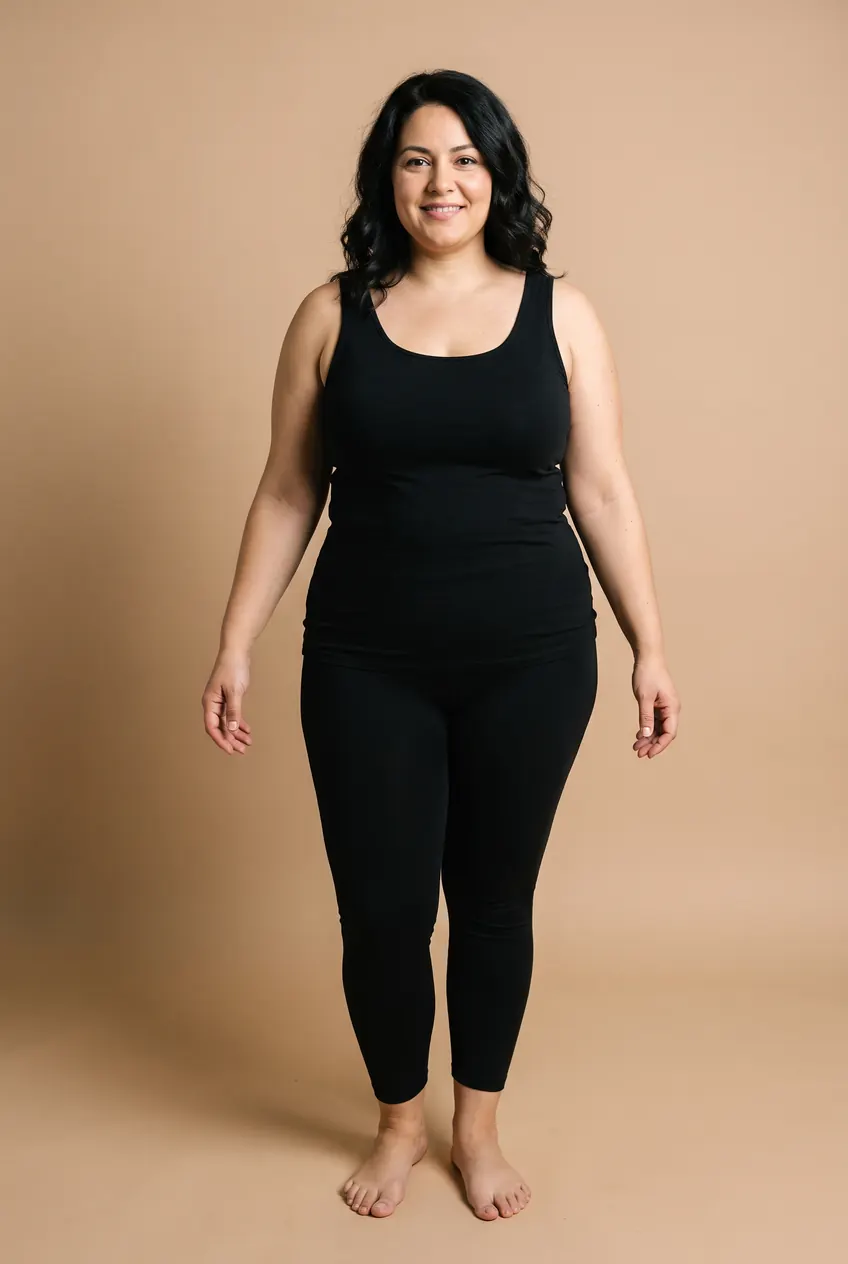
Starting photoThe photo every try-on here was made from
- A fitted tank and leggings show the outline clearly, which is what a try-on needs.
- Her shoulders and hips are close in width, with a softly defined waist.
- Every image on the other cards was made from this one photo.
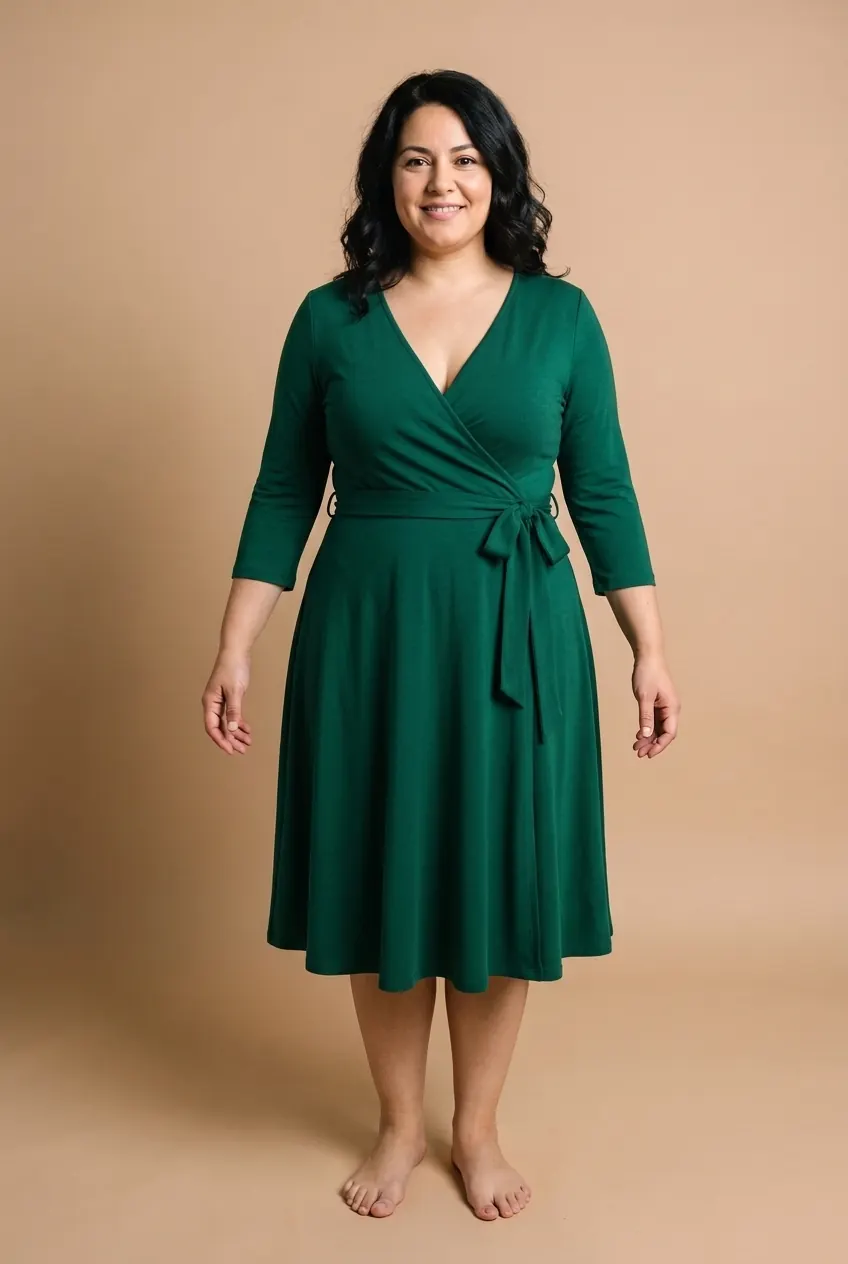
Wrap dressWedding guest
- The crossover makes one long V from the collarbone to the waist.
- The tie sits at her natural waist, the narrowest point of her frame.
- Jersey skims the hips, and the knee-length skirt swings clear of them.
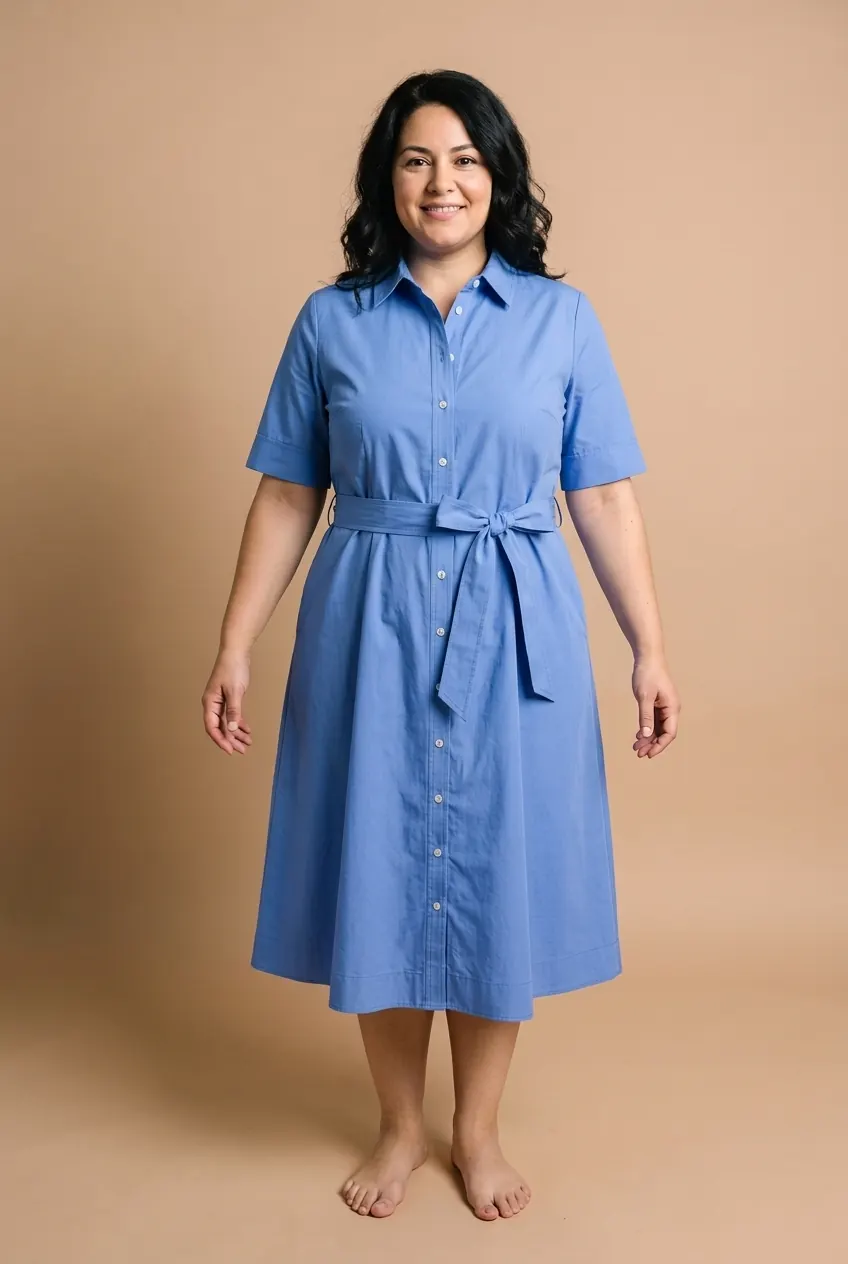
Shirt dressWork
- Collar and button placket draw a vertical line from neck to hem.
- The tie belt marks the waist and the A-line skirt falls past the hips.
- Crisp poplin stands slightly away from the body instead of clinging.
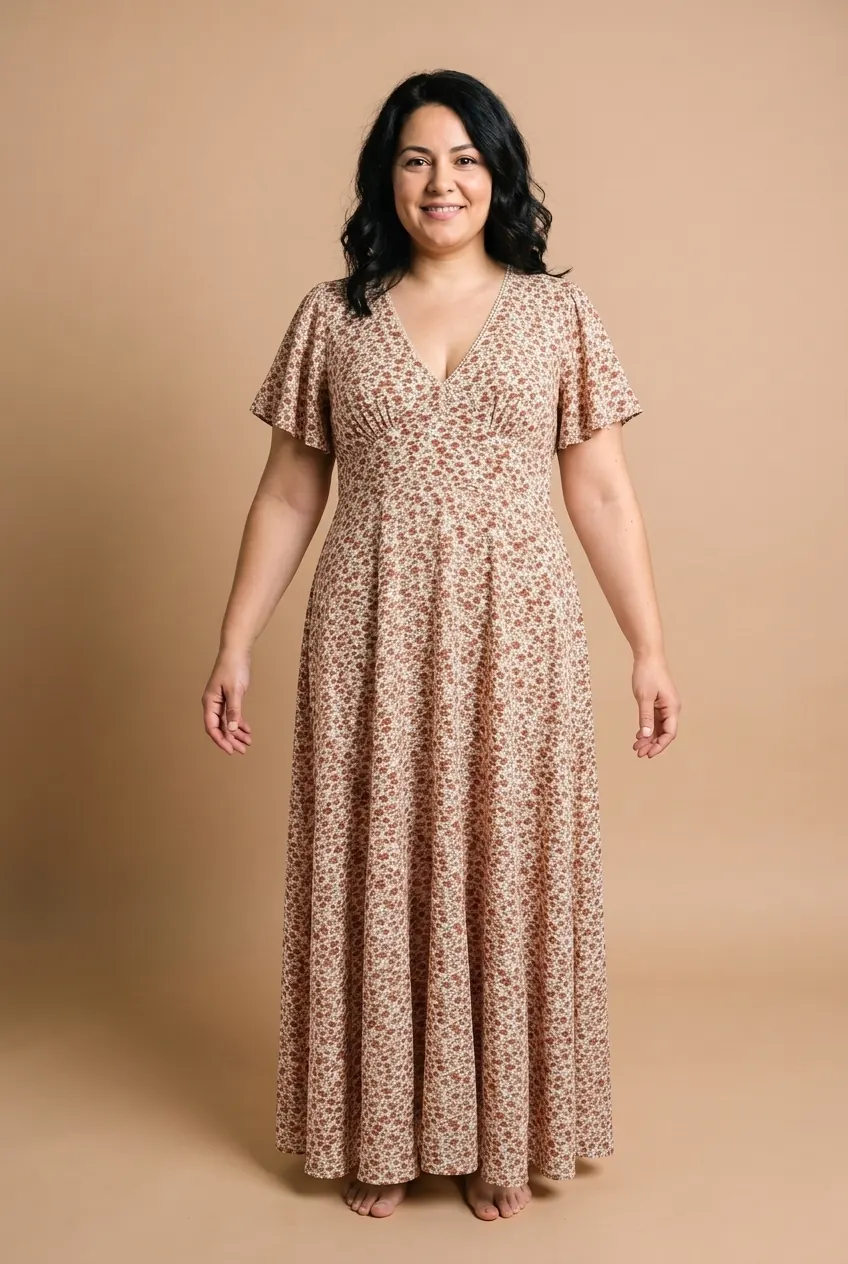
Empire maxiSummer casual
- The seam sits right under the bust; everything below falls freely.
- The V neckline and soft gathers lengthen the torso.
- Flutter sleeves cover the shoulder without adding stiffness.
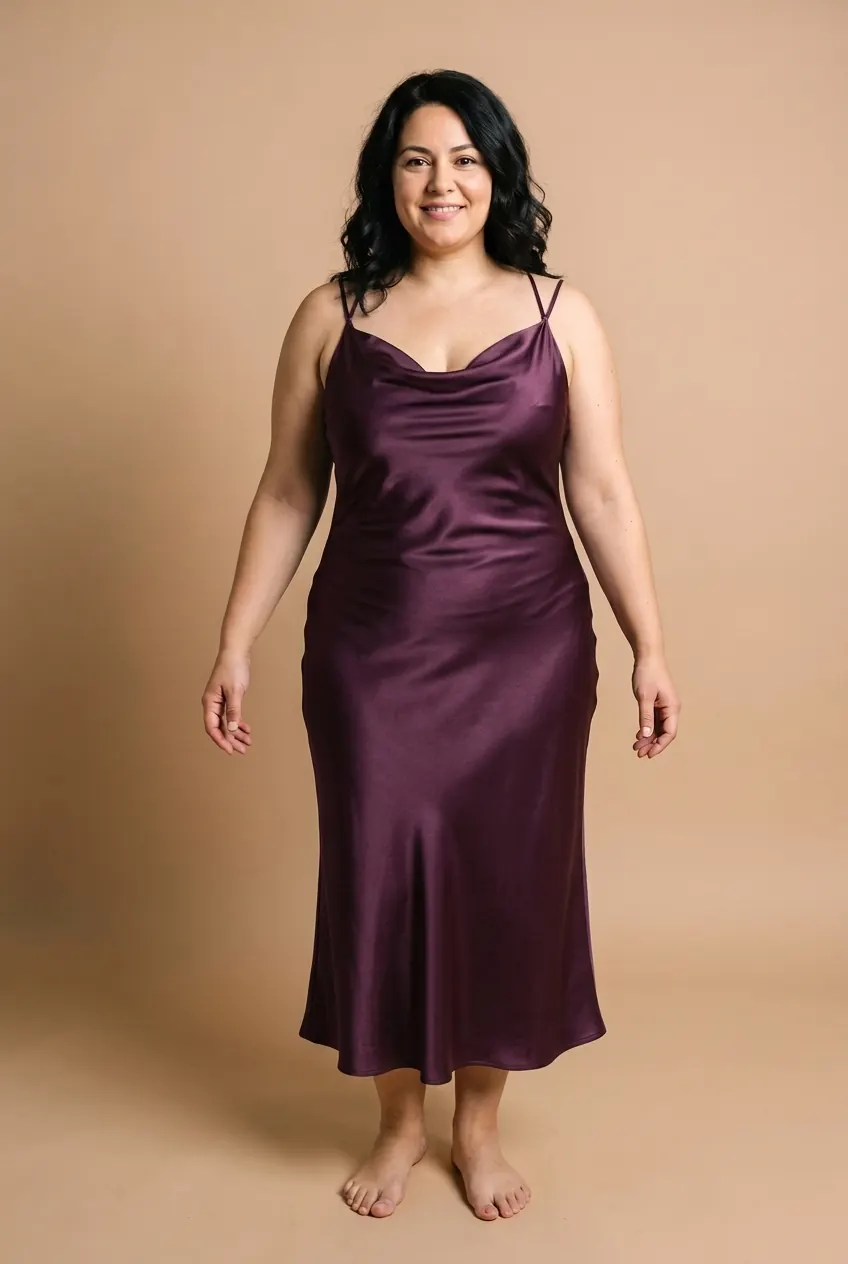
Slip dressCocktail
- The cowl drapes softly at the bust.
- Satin follows every curve, so this is the most body-skimming of the four.
- Cut on the bias, it moves as she does; a heavier satin and the right size matter most here.
One original photo, four AI try-on examples made with FitInView's try-on. The model and the dresses are AI-generated, so no real customer is shown.
your size, your photo
Pin your own photo to the pattern
Upload a photo of yourself and a photo or shop link of a dress, and FitInView creates an image of you wearing it. See a cut on your own body before you order it, alter it or wear it out.
Your first try-on is included with a free account. No card needed. Your photos are private to your account, and you can delete them.
How a dressmaker reads each shape
A dressmaker does not ask what to cover. She asks where the eye should travel and which line to follow. Here is that thinking for each shape, with three cuts worth trying first.
Hourglass
Bust and hips about the same width, with a clearly narrower waist.
Follow the waist instead of skipping over it. Dresses shaped at the waist, in fabrics that drape, sit closest to your natural lines.
try first: wrap dress, sheath dress, fit-and-flare
Pear
Hips noticeably wider than shoulders and bust, usually with a defined waist.
Bring the eye up and out at the shoulders, keep the waist marked, and let the skirt move past the hips with ease instead of gripping them.
try first: a-line dress, fit-and-flare, empire waist
Apple
Fullest through the middle, often with a fuller bust and slimmer legs; the waist is less defined.
Long vertical lines and fabrics that skim instead of cling. Let the dress take its shape from the bust or the shoulders and fall freely past the middle.
try first: empire waist, shift dress, wrap dress
Rectangle
Shoulders, waist and hips of similar width: a straight, balanced frame (sometimes called athletic).
Two good routes: build a waist with seams, belts and wraps, or lean into the straight line with shifts, columns and slips. Both work; pick the mood you want.
try first: shirt dress, slip dress, drop waist
Inverted triangle
Shoulders or bust noticeably wider than the hips, often with slim hips and legs.
Keep the shoulder line simple, draw the eye down the center, and add movement below the waist so the skirt balances the top.
try first: a-line dress, fit-and-flare, drop waist
The neckline does half the work
It frames the face and decides where the eye lands first. A V draws it down, a boat neck draws it across, a halter pulls it in. Thirteen necklines, drawn and explained, in the neckline guide.
Open the neckline guideDress guides
- Neckline guideThirteen necklines drawn and explained, with an explorer for bust, shoulders and shape.
- Dress length guideEight dress lengths, and a hem planner that shows where a listed length ends on you.
- Wedding guest dressesThe right cut for your shape, the dress code and the venue, and the colors to skip.
- Work dressesSheath, shirt dress, wrap or shift: office cuts by shape, fabrics and the desk test.
- Maxi dressesEmpire, wrap, tiered or slip: maxi cuts by shape, and how height changes them.
Questions people ask about dresses and body shape
Which dress style suits every body shape?
There is no single one, but the wrap dress and the A-line come closest. A wrap adjusts at the waist and makes a V neckline; an A-line fits at the top and skims everything below. Both come in many fabrics and lengths, so they work from the office to a wedding.
How do I find my body shape for dresses?
Compare three widths in a mirror or with a tape measure: shoulders or bust, waist, and hips. The three-question check in the finder gives you the closest shape. If you sit between two, read both; the advice often overlaps.
What dress is best for a fuller tummy?
Empire waists, wrap dresses with ruching and shifts in a fabric with some weight usually sit best, because they take their shape from the bust or shoulders and fall past the middle. A V neckline adds a long vertical line.
Do I have to follow these suggestions?
No. They are a dressmaker’s rules of thumb about balance and emphasis, useful when you are unsure or shopping online. If you love a dress that breaks them, wear it.
Does height change the advice?
Mostly the length. Shorter women often find knee or just-below-knee hems and ankle-length maxis easiest to wear; taller women carry midi lengths and full skirts with less fuss. Compare the listed dress length with your own measurements, as the dress length guide shows.
Can I see a dress on my own body before buying?
Yes, as a visual preview. Upload a photo of yourself and a photo or shop link of a dress, and FitInView creates an image of you wearing it. It shows the cut and the line, not a measured fit, so still check the size chart. Your first try-on is included with a free account. No card needed.